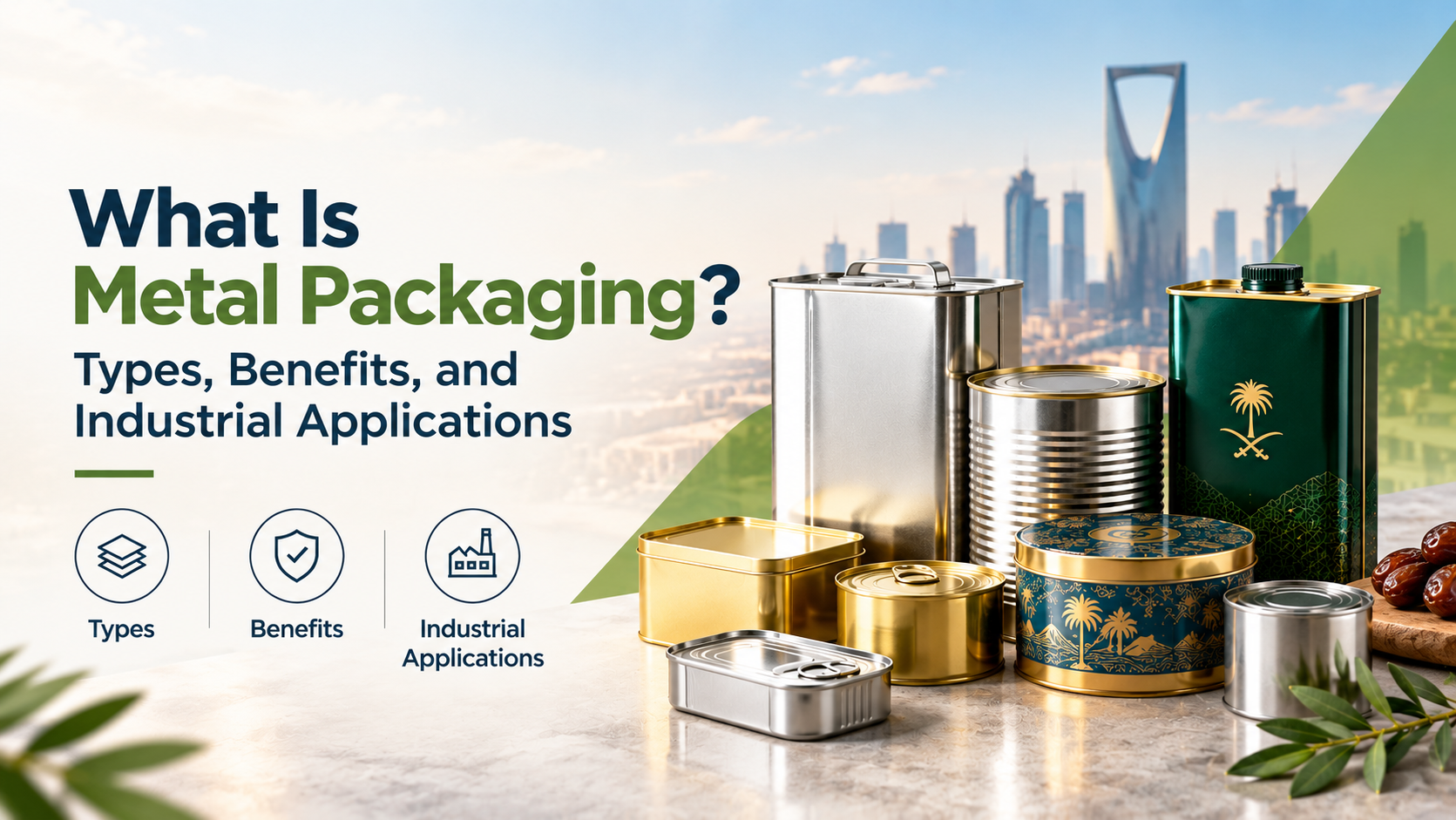
What Is Metal Packaging? Types, Benefits, and Industrial Applications
Packaging plays an important role in protecting products, maintaining quality, supporting transportation, and presenting a brand to customers. From food and edible oils to industrial materials and premium gift collections, businesses need packaging that meets the specific requirements of their products.
Metal packaging is one of the most widely used packaging options across different industries because of its strength, durability, protective properties, and design flexibility. Depending on the material, container design, and closure, metal packaging can help protect products from light, moisture, air, and external contamination while providing a practical and attractive presentation.
For manufacturers and businesses in Saudi Arabia, metal packaging also offers opportunities to combine reliable product protection with customized branding and locally manufactured packaging solutions.
But what exactly is metal packaging? What types are available, and how can businesses determine which option is right for their products?
This guide explains the different types of metal packaging, its key benefits, common industrial applications, and the factors businesses should consider when choosing a metal packaging solution.
What Is Metal Packaging?
Metal packaging refers to containers, cans, tins, and other packaging products manufactured using metals such as steel, tinplate, and aluminum. These materials are formed into different shapes and sizes to store, protect, transport, and present a wide range of products.
Depending on the application, metal packaging may feature protective coatings, specialized closures, printed designs, or embossed finishes. These features help manufacturers create packaging that meets specific functional, safety, and branding requirements.
Metal packaging is commonly used for food products, edible oils, beverages, confectionery, cosmetics, paints, and various industrial materials.
For example, a food manufacturer may use metal tins for dates, chocolates, or dry foods, while an edible oil producer may require larger metal containers with suitable closures. A brand selling premium products may choose custom-printed metal packaging to create a distinctive appearance on retail shelves.
Although the applications differ, the objective remains similar: to select packaging that protects the product, supports its intended use, and meets the expectations of the business and its customers.
What Materials Are Used in Metal Packaging?
The performance of metal packaging depends partly on the material used to manufacture it. Steel, tinplate, and aluminum are among the materials commonly associated with metal packaging, although their properties and applications differ.
1. Tinplate
Tinplate is steel sheet coated with a thin layer of tin. The steel provides strength, while the tin coating helps improve corrosion resistance.
Tinplate is widely used for food cans, metal tins, confectionery packaging, and containers for various commercial applications. Additional protective coatings may be applied when the contents require specific material compatibility.
Its strength and suitability for custom printing make it a practical choice for businesses seeking durable packaging with a branded finish.
2. Steel
Steel is valued for its strength and structural durability. Depending on the grade, coating, and container design, steel packaging can be suitable for applications ranging from food containers to industrial cans and larger metal packages.
Manufacturers can form steel into different shapes and incorporate suitable closures to meet product-specific requirements.
Steel packaging is particularly useful when a container needs to maintain its structure during handling, storage, and transportation.
3. Aluminum
Aluminum is lightweight and naturally forms a protective oxide layer on its surface. It is commonly used in beverage cans, aerosol containers, foil packaging, and other applications where its material properties are beneficial.
Its relatively low weight can help reduce packaging weight during transportation, while its formability supports a wide range of container designs.
However, aluminum and steel are not interchangeable in every application. The appropriate material depends on the product being packaged, required barrier properties, manufacturing processes, cost, and intended use.
How Should Businesses Choose Between These Materials?
There is no single material that is best for every product.
Before selecting a metal packaging material, businesses should consider:
- The type and chemical properties of the contents.
- Whether the product is solid, powdered, or liquid.
- The required level of protection from light, oxygen, and moisture.
- The container's intended storage conditions.
- The closure and sealing requirements.
- The printing, coating, and branding specifications.
- The total packaging and transportation costs.
For food and other sensitive products, material suitability and any required internal coating should be confirmed for the specific application.
What Are the Main Types of Metal Packaging?
Metal packaging is available in different forms to accommodate the requirements of food manufacturers, retailers, industrial businesses, and consumer brands.
Understanding these types can help businesses narrow down their options before discussing specifications with a packaging manufacturer.
1. Metal Cans
Metal cans are used to package a wide variety of products, including foods, beverages, and certain industrial materials.
Their construction can provide strength and, when properly designed and sealed, effective protection against external conditions. Some cans are designed for long-term storage, while others are intended for retail presentation or specialized uses.
The appropriate can depends on the product, filling process, required shelf life, opening mechanism, and distribution environment.
For food manufacturers, for example, the choice between a standard can and a specialized container may depend on whether the product requires hermetic sealing, retort processing, or another preservation method.
2. Metal Tins and Decorative Tin Boxes
Metal tins are commonly used for products where presentation, durability, and reusability are important.
They are particularly suitable for premium dates, chocolates, sweets, biscuits, dry foods, gifts, and promotional collections, provided that the material and internal surfaces are appropriate for the intended contents.
Metal tins are available in round, square, rectangular, and other custom shapes. Businesses can also customize their dimensions, printed artwork, finishes, and selected design features.
For premium brands, this flexibility allows packaging to become part of the overall product experience rather than simply a container.
For example, a dates brand preparing a seasonal gift collection may choose a square metal tin with custom printing to reflect its visual identity and create a more distinctive presentation.
3. Metal Containers for Edible Oils
Edible oils require packaging that helps maintain product quality while supporting safe handling, storage, and distribution.
Metal containers are used for products such as olive oil and other edible oils. Depending on the application, suitable metal packaging can help limit exposure to light and provide a durable barrier against external conditions.
These containers may be designed for household use, retail distribution, restaurants, food-service operations, or bulk storage.
Container capacity, closure design, filling requirements, and compatibility with the particular oil should be considered before selecting a package.
For example, a small retail pack may require a convenient closure and attractive printed design, whereas a larger food-service container may prioritize capacity, secure handling, and efficient storage.
The right choice depends on how the product will be filled, stored, transported, and used.
4. Metal Containers for Industrial Products
Metal packaging also serves businesses that manufacture and distribute non-food products.
Depending on the material, coating, closure, and regulatory requirements, metal containers may be used for paints, coatings, adhesives, lubricants, and certain chemicals.
Industrial applications can place different demands on packaging. A container may need to withstand repeated handling, prevent leakage, accommodate a particular filling process, or remain compatible with its contents.
For this reason, businesses should not select an industrial metal container based on appearance or capacity alone.
The packaging manufacturer and product supplier should confirm that the container is suitable for the specific substance and operating conditions.
5. Custom-Printed Metal Packaging
Custom-printed metal packaging combines the functional properties of a metal container with graphics and design elements that reflect a brand's identity.
Printing options vary by manufacturer and product. They may include offset printing, lithography, selected digital printing methods, protective lacquers, and different surface finishes.
Depending on the design and production process, businesses may also be able to select embossing or other decorative features.
Custom printing can be particularly useful for:
- Food and confectionery brands.
- Premium dates and gift collections.
- Corporate gifts and promotional products.
- Seasonal packaging for Ramadan and Eid.
- Retail products that require consistent brand presentation.
The main advantage is the ability to create packaging that supports both the product's functional requirements and its visual identity.
However, businesses should confirm available printing methods, minimum order quantities, artwork requirements, and production lead times before finalizing a design.
What Are the Benefits of Metal Packaging?
Metal packaging offers several practical advantages, but its suitability depends on the product, the container design, and the conditions in which it will be used.
Here are some of the main benefits businesses consider when evaluating metal packaging.
1. Strong and Durable Construction
One of the primary advantages of metal packaging is its structural strength.
Compared with many flexible packaging materials, metal containers can maintain their shape under normal handling conditions and help protect their contents from certain physical impacts.
This can be useful for products that pass through several stages of storage, transportation, distribution, and retail handling.
However, metal containers can still dent, deform, or become damaged under excessive force. Their actual performance depends on the metal thickness, design, construction, and handling conditions.
2. Protection Against External Conditions
Appropriately designed metal packaging can provide an effective barrier against light, oxygen, moisture, and other external influences.
This is especially relevant for products whose quality may be affected by exposure to light or oxygen.
For example, light-sensitive edible oils may benefit from packaging that limits light exposure. Certain food products may also require packaging that reduces moisture transfer or protects against contamination.
The level of protection depends on the container construction, seams, closures, coatings, and filling process.
Metal packaging does not automatically guarantee a particular shelf life. Manufacturers must select and validate a suitable packaging system for the product and its intended storage conditions.
3. Suitable Options for Food Packaging
Metal packaging is widely used in food applications because suitable materials and container designs can provide reliable protection.
Food products such as dates, confectionery, chocolates, dry foods, and edible oils may be packaged in metal containers designed for their specific requirements.
However, not every metal container is suitable for direct food contact.
Food packaging must use appropriate materials, coatings, and closures, and comply with applicable food-contact requirements. Businesses should verify that the complete packaging system is suitable for the food being packaged.
This is particularly important when a product contains oils, acidic ingredients, or other substances that may interact with the container's internal surfaces.
4. Opportunities for Custom Branding
Packaging is often one of the first things customers notice about a product.
Metal packaging offers a durable surface for displaying brand names, product information, colors, illustrations, and other visual elements.
Depending on the manufacturing process, businesses can explore different shapes, printing styles, and finishes to create a package that reflects their positioning.
For premium brands, custom metal tins can support a more distinctive retail presentation.
For established manufacturers, consistent packaging design can help maintain a recognizable appearance across product ranges.
For seasonal products, customized tins can also support limited-edition collections and special gift packaging.
The result is an opportunity to combine product protection with a recognizable brand presentation.
5. Flexible Shapes and Sizes
Metal packaging is not limited to one standard shape.
Depending on the manufacturer's capabilities and tooling, containers can be produced in round, square, rectangular, cylindrical, and selected custom forms.
Different heights, capacities, closures, and surface finishes may also be available.
This flexibility allows businesses to choose packaging according to their product dimensions, storage requirements, filling process, and retail presentation.
For example, a confectionery business may prefer a shallow tin for an assortment of sweets, while a food manufacturer may require a taller container or a larger metal package for a different product.
The key is to balance design preferences with functional requirements and manufacturing feasibility.
6. Potential for Reuse
Durable metal tins can often be reused after their original contents have been consumed, provided that their design and condition make reuse appropriate.
Consumers may repurpose decorative tins for storing household items, organizing small objects, or keeping non-food materials.
This can extend the useful life of the container and give packaging additional value beyond its original purpose.
However, reuse should not be confused with guaranteed food safety. A container designed for a particular product may not be suitable for storing a different food or liquid later, especially if it has been damaged or cannot be cleaned properly.
Businesses should also distinguish reusable packaging from packaging specifically designed for repeated commercial filling and distribution.
7. Recyclability
Steel and aluminum are recyclable materials, and metal packaging can be recovered and reprocessed through appropriate recycling systems.
Metal recycling can help reduce demand for virgin raw materials, although the overall environmental benefit depends on factors such as collection rates, recycling infrastructure, processing methods, energy sources, and transportation.
Actual recycling outcomes also depend on local waste-management arrangements and the condition of the discarded packaging.
For businesses seeking to make more informed packaging decisions, recyclability is an important consideration alongside product protection, material use, manufacturing efficiency, and end-of-life management.
Rather than assuming one packaging material is always environmentally preferable, businesses should evaluate the complete packaging system and its intended lifecycle.
8. Support for Premium Product Presentation
Metal tins can provide a distinctive appearance for products positioned around quality, gifting, or premium presentation.
A well-designed tin with suitable printing and finishing can help a product stand out in a retail environment or create a more polished presentation for corporate gifts.
This is particularly relevant to dates, chocolates, sweets, and specialty food products sold in competitive markets.
For brands operating in Saudi Arabia, customized metal packaging can also support seasonal collections and gift assortments developed for occasions such as Ramadan and Eid.
The design should complement the product, reflect the target audience, and remain practical for storage, transportation, and use.
9. Options for Different Business Sizes
Metal packaging is used by both established manufacturers and growing brands.
Depending on the supplier, available production methods, and product specifications, businesses may be able to choose between existing container designs and more customized solutions.
Standard products can be useful when a business needs a straightforward packaging option, while custom tooling may be appropriate when a particular shape or dimension is necessary.
Order quantities, unit costs, setup requirements, and lead times should be considered together.
A lower unit price at a high production volume does not necessarily represent the best choice for a business with uncertain demand or limited storage capacity.
The best packaging solution is one that meets the business's requirements without creating unnecessary costs or operational complexity.
Industrial Applications of Metal Packaging
Metal packaging serves a wide range of industries. Its applications depend on the properties of the metal, the container design, and the requirements of the product being packaged.
1. Food and Beverage Industry
The food industry uses metal packaging for products that require durable containers and suitable protection from external conditions.
Applications include:
- Canned food products.
- Dry foods and powdered products.
- Dates and date-based gift collections.
- Chocolates, sweets, and confectionery.
- Edible oils and selected liquid foods.
- Specialty and premium food products.
The choice of packaging depends on the product's moisture content, acidity, oil content, filling process, intended shelf life, and storage environment.
For example, a dry confectionery product may require different protection from a liquid food that needs a secure closure.
Food manufacturers should confirm material suitability, coating compatibility, sealing performance, and any required food-contact compliance before production begins.
2. Dates and Confectionery
Dates and confectionery are particularly relevant applications for premium metal tins.
Brands selling dates, chocolates, biscuits, sweets, and assorted treats may choose metal packaging to combine protection with presentation.
Custom printing can display product branding, ingredient information, decorative patterns, and seasonal designs, subject to applicable labeling requirements.
The package's shape and dimensions should be selected according to the quantity and arrangement of the contents.
For gift-oriented products, a distinctive tin can also create an opportunity for reuse after the original product has been consumed.
Businesses should consider the entire package, including the lid, internal arrangement, product-contact materials, and transport requirements.
3. Edible Oils and Food-Service Businesses
Producers and distributors of olive oil and other edible oils may use metal containers in different sizes for retail, commercial, and food-service applications.
Suitable metal packaging can help limit light exposure and provide a sturdy container for handling and storage.
The correct container should match the oil's characteristics and the requirements of the filling and distribution process.
Closure integrity is especially important when containers hold liquids. Businesses should assess leakage prevention, ease of opening, dispensing needs, storage orientation, and transportation conditions.
Restaurants, cafés, wholesalers, and food manufacturers may also have different requirements for container capacity and handling.
4. Paints, Coatings, and Adhesives
Metal containers are used for various paints, coatings, and adhesives where their strength and closure options meet the product's requirements.
These applications may involve substances that are sensitive to air, moisture, or other environmental conditions.
However, compatibility cannot be assumed simply because a container is made from metal.
The product's chemical composition, viscosity, storage conditions, coating compatibility, and closure requirements must all be evaluated.
Industrial buyers should work with the relevant packaging supplier to confirm whether a particular container is appropriate for the intended material and applicable regulations.
5. Cosmetics and Personal Care
Some cosmetic and personal-care products use metal tins, jars, and other metal packaging formats.
Examples may include selected solid cosmetics, balms, specialty products, and gift collections.
Metal packaging can offer a durable exterior and a surface suitable for branding. However, product-contact compatibility, corrosion resistance, closure performance, and hygiene requirements must be evaluated for each formulation.
The packaging must be suitable for the particular product and meet relevant regulatory requirements.
6. Corporate Gifts and Promotional Products
Businesses often use customized packaging for corporate gifts, promotional collections, and special events.
Metal tins can accommodate suitable gift items, confectionery, and branded merchandise while providing an alternative to conventional cardboard boxes or flexible packaging.
Companies can customize the appearance to reflect a corporate identity, campaign, event, or seasonal theme.
For businesses in Saudi Arabia, this can be particularly relevant when preparing gift collections for customers, employees, business partners, or seasonal occasions.
The packaging design should reflect the intended recipient and purpose while remaining practical to produce, store, and distribute.
7. Manufacturing and Industrial Supply Chains
Metal containers also play a role in broader manufacturing and industrial supply chains.
Depending on the application, they may be used to package materials that require sturdy containers, suitable closures, or specific protective properties.
Industrial packaging decisions often involve more than the initial purchase price. Businesses must consider compatibility, handling, storage efficiency, filling operations, transportation, and disposal.
A container that works well for one product may be unsuitable for another, even if both products are manufactured by the same company.
For this reason, packaging selection should be based on the complete operational requirements rather than a general preference for metal containers.
Metal Packaging vs. Plastic Packaging: What Is the Difference?
Metal and plastic packaging both serve important roles across manufacturing, retail, and distribution.
The right choice depends on the product, the level of protection required, the packaging format, the intended use, and the total cost.
FactorMetal PackagingPlastic PackagingStructural strengthOften provides strong structural support, depending on design and thicknessVaries considerably by plastic type, thickness, and constructionWeightCan be heavier than comparable plastic packagingOften lightweightProtection from lightOpaque metal containers block light through the container wallsDepends on the plastic type, color, thickness, and barrier designOxygen and moisture barrierCan provide an effective barrier when the container and closure are properly designedVaries by polymer and packaging constructionShape flexibilityCan be formed into various shapes, with tooling requirements for many custom designsSupports a wide range of shapes and manufacturing methodsBrandingSupports printing, coatings, embossing, and selected decorative finishesSupports labels, direct printing, molded details, and other finishesRecyclabilitySteel and aluminum are recyclable through suitable systemsDepends on the polymer, collection systems, and recycling infrastructureReuseSome tins and containers can be reused when suitable and undamagedSome formats can also be reused, depending on their design and intended useCost considerationsDepends on material, tooling, finishing, order volume, and production methodDepends on resin, forming method, design, volume, and production method
Which Option Is Better?
Neither material is universally better.
Metal packaging may be a suitable choice when a product requires an opaque, durable container, a particular barrier performance, or a premium printed finish.
Plastic packaging may be more suitable when low weight, flexibility, squeezability, or a specific container design is a priority.
Some products can be packaged successfully using either material, while others require specialized packaging based on their physical or chemical properties.
Businesses should compare complete packaging systems rather than considering the container material in isolation.
How to Choose the Right Metal Packaging for Your Business
Selecting packaging involves balancing product protection, practical requirements, branding, and cost.
Before choosing a metal container, businesses should evaluate the following factors.
1. Identify the Product Requirements
Start by identifying exactly what the package will contain.
Is it a dry food, an edible oil, a confectionery product, a cosmetic formulation, or an industrial material?
Consider the product's physical and chemical properties, its sensitivity to light or oxygen, and any compatibility requirements.
This information helps determine which materials, coatings, and container formats may be appropriate.
2. Determine the Required Capacity and Dimensions
The container should accommodate the intended quantity without unnecessary space or impractical dimensions.
Consider the product's volume, weight, arrangement, and filling process.
Also evaluate how the container will fit into cartons, storage racks, shipping cases, and retail displays.
For products sold in several sizes, consistent design elements can help create a recognizable product range.
3. Evaluate Closure and Sealing Requirements
Different products require different closure systems.
A decorative tin for dry sweets may use a removable lid, while a liquid product may require a closure designed to provide suitable leak resistance.
Products requiring hermetic sealing or specialized preservation processes need packaging specifically designed and validated for those requirements.
Businesses should consider ease of opening, dispensing, resealing, transport, and storage when selecting a closure.
4. Consider Printing and Branding
If packaging is part of the product's retail presentation, determine which design features matter most.
These may include:
- Brand colors and logo placement.
- Product names and required labeling.
- Printed patterns or illustrations.
- Matte or gloss finishes.
- Embossed or debossed details.
- Custom shapes or dimensions.
The available options depend on the manufacturer's production capabilities, minimum order quantities, and tooling requirements.
Final artwork should be reviewed against the actual container dimensions and printing specifications before production.
5. Check Quality and Compliance Requirements
Packaging quality affects product protection, consistency, and operational reliability.
Businesses should ask relevant questions about material specifications, coating suitability, manufacturing tolerances, closure performance, inspection procedures, and applicable certifications.
For food products, confirm that all components that contact the product are suitable for the intended food and comply with relevant requirements.
For industrial products, confirm chemical compatibility and any applicable transport, storage, or regulatory requirements.
6. Compare Total Costs
The cost of packaging includes more than the price of an individual container.
Depending on the project, additional factors may include:
- Artwork preparation.
- Custom tooling.
- Printing and finishing.
- Minimum order quantities.
- Filling and packing operations.
- Shipping and storage.
- Product damage or leakage risks.
- Inventory and replenishment requirements.
A suitable packaging solution should balance upfront investment with long-term operational needs.
7. Work With a Manufacturer That Understands Your Requirements
An experienced packaging manufacturer can help assess dimensions, material choices, printing options, production requirements, and the feasibility of a custom design.
When requesting a quotation, provide as much relevant information as possible, including the product type, required capacity, preferred shape, expected order quantity, branding needs, and delivery location.
Clear specifications make it easier to assess whether a proposed solution meets the business's requirements.
Why Custom Metal Packaging Matters for Brands in Saudi Arabia
Saudi Arabia has businesses operating across food production, retail, hospitality, manufacturing, and other sectors that require dependable packaging.
For these businesses, packaging must meet practical requirements while supporting product presentation and distribution.
Custom metal packaging provides an opportunity to develop containers around a brand's specific needs rather than relying exclusively on standard designs.
For example, a dates producer may require branded tins for a premium product line, while an edible oil business may need containers with suitable capacities and closures for retail or commercial customers.
A confectionery company may prioritize printing and presentation, whereas an industrial manufacturer may focus on compatibility, durability, and operational performance.
The ideal solution depends on the intended application.
The Value of Local Manufacturing
Working with a Saudi-based packaging manufacturer can offer practical advantages for businesses sourcing packaging within the Kingdom.
Depending on production capacity and order specifications, local manufacturing may help simplify communication, facilitate design discussions, and reduce dependence on international shipping for certain products.
It can also make it easier to discuss customization requirements with a supplier operating in the same market.
However, lead times, pricing, minimum order quantities, and delivery arrangements should always be confirmed for the specific project.
Local sourcing is most effective when the manufacturer can meet the required specifications, quality expectations, production volumes, and delivery schedule.
How Tinova Supports Metal Packaging Requirements
Tinova is a metal packaging manufacturer based in Riyadh, Saudi Arabia, providing metal packaging options for commercial and industrial customers.
Its product range includes metal tins and containers intended for applications such as dates, sweets, chocolates, dry foods, edible oils, and selected other uses.
Businesses can explore available products and discuss packaging requirements according to their intended application.
Metal Packaging for Food and Premium Products
Tinova offers metal tins in different shapes and dimensions for applications including dates, confectionery, chocolates, dry foods, gifts, and promotional products.
These formats provide businesses with options for combining practical packaging with custom product presentation.
Depending on the product and manufacturing specifications, businesses can discuss the appropriate container dimensions, printing requirements, and finishing options.
Metal Containers for Edible Oils
Tinova also offers metal containers in different capacities for olive oil, tahini, and other suitable liquid food applications.
When selecting a container, customers should confirm that its material, internal coating, and closure are appropriate for the specific contents and intended filling process.
Customization and Branding
Tinova supports customized metal packaging requirements, with options depending on the selected product and production specifications.
Businesses can discuss suitable shapes, dimensions, printing, and finishing to determine how their packaging can reflect their brand identity.
Customization requirements should be reviewed early in the process, particularly when a project involves new tooling, specialized closures, or large production volumes.
Manufacturing in Saudi Arabia
With its manufacturing facility in Riyadh, Tinova serves businesses seeking metal packaging produced within Saudi Arabia.
For companies evaluating packaging suppliers, the important considerations include product suitability, manufacturing quality, customization capabilities, order quantities, pricing, and delivery requirements.
Tinova's team can discuss these factors with businesses looking for packaging options suited to their products.
Explore the available options through Tinova's metal packaging product catalogue.
Frequently Asked Questions About Metal Packaging
1. What is metal packaging used for?
Metal packaging is used to store, protect, transport, and present products across industries such as food and beverage, confectionery, cosmetics, manufacturing, and selected industrial applications.
Common formats include metal cans, tins, containers, and specialized packages designed for particular products.
2. What materials are commonly used in metal packaging?
Steel, tinplate, and aluminum are common materials used in metal packaging.
The choice depends on the product's requirements, desired container properties, manufacturing process, coatings, closure design, and budget.
3. Is metal packaging suitable for food products?
Yes, appropriately designed metal packaging is widely used for food products.
However, the container, internal coating, closure, and other product-contact components must be suitable for the specific food and comply with applicable requirements.
Not every metal container is suitable for every food application.
4. Does metal packaging help protect food freshness?
Metal packaging can provide an effective barrier against light, oxygen, moisture, and external contamination when the container is properly designed and sealed.
The level of protection depends on the package, closure, product, filling method, and storage conditions.
Shelf life must be established for the specific product and packaging system.
5. Is metal packaging recyclable?
Steel and aluminum are recyclable materials, and metal packaging can be recycled through appropriate collection and processing systems.
Actual recycling outcomes depend on local infrastructure, collection practices, material recovery, and other factors.
6. Can metal packaging be customized?
Yes. Depending on the manufacturer and product, customization may include container dimensions, shapes, printed artwork, coatings, surface finishes, and selected decorative features.
Some designs may require specialized tooling or higher order quantities.
7. Is metal packaging more expensive than plastic packaging?
The cost depends on the material, container design, production method, order quantity, printing, finishing, and logistics.
Metal packaging may have a higher unit cost in some applications, but the complete comparison should also consider product protection, presentation, durability, and operational requirements.
Businesses should compare quotations for packaging that meets the same functional requirements.
8. What industries use metal packaging?
Metal packaging is used in food and beverage production, dates and confectionery, edible oils, cosmetics, paints, coatings, and various manufacturing applications.
The suitability of a particular container depends on its material, design, coating, closure, and intended use.
9. How do I choose a metal packaging supplier in Saudi Arabia?
Evaluate the supplier's manufacturing capabilities, product range, customization options, quality-control processes, relevant certifications, minimum order quantities, pricing, and delivery arrangements.
Provide clear product specifications and confirm that the proposed packaging is suitable for your application before placing an order.
10. Where can I find a metal packaging manufacturer in Saudi Arabia?
Businesses can explore Saudi-based manufacturers that offer metal containers and custom packaging solutions.
Tinova, based in Riyadh, provides metal packaging options for applications including dates, sweets, chocolates, dry foods, and edible oils. Businesses can contact its team to discuss their packaging requirements and request a quotation.
Conclusion
Metal packaging remains an important option for businesses that need durable containers, suitable product protection, and flexible presentation choices.
From metal cans and food tins to edible oil containers and custom-printed packaging, the available formats serve different purposes across commercial and industrial markets.
Its main advantages include structural strength, effective barrier properties when properly designed, customization opportunities, and the recyclability of materials such as steel and aluminum. However, the right solution depends on the product, packaging specifications, regulatory requirements, and intended use.
For businesses in Saudi Arabia, working with a capable local manufacturer can make it easier to discuss packaging requirements, explore customization options, and evaluate suitable products.
Tinova provides metal packaging options manufactured in Riyadh, Saudi Arabia, for businesses looking to combine practical packaging requirements with professional product presentation.
Looking for metal packaging for your business?
Whether you need metal tins for dates and confectionery, containers for edible oils, or customized packaging for your brand, Tinova can help you explore suitable options.
Visit the Tinova product catalogue to explore available metal packaging solutions, or contact Tinova to discuss your requirements and request a quotation.